Scratch Resistant Coatings
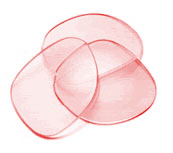 Note
the term “Resistant”, nothing is scratch proof.
That said, scratch coatings are a definite plus,
greatly enhancing the lenses ability to resist
scratching. Other than stock lenses where the
prescription is already in the lens, most
scratch coatings are front surface only. Your
lab can add either a standard, or in some cases
a super tough back surface scratch coating at an
additional charge.
Note
the term “Resistant”, nothing is scratch proof.
That said, scratch coatings are a definite plus,
greatly enhancing the lenses ability to resist
scratching. Other than stock lenses where the
prescription is already in the lens, most
scratch coatings are front surface only. Your
lab can add either a standard, or in some cases
a super tough back surface scratch coating at an
additional charge.
Super Tough Scratch Coatings
The Super Tough Scratch Coatings are a fairly new
enhancement and well worth the small extra cost they usually carry. This is
especially helpful under an AR coating. Some coatings will not take a tint
well, or at all. Check with your lab!
Return to Top
AR Coatings
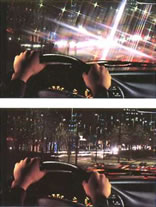 Anti-Reflective
(AR) Coatings reduce reflections inside the lens, enhancing colors, clarity
and light coming through to the eyes. Lenses without AR lose from 8% to 18%
of the light because of these reflections depending on the index of
refraction of the material. The higher the index, the more reflections!
Today’s AR is a vast improvement to the coatings we used even a few short
years ago. Various layers of coatings, sometimes including the newer,
tougher scratch coatings, primer coats and hydrophobic coatings have taken a
good product and made it great. Plus, we’ve learned that we must have the
correct combination of materials and coatings to work properly together.
This enhancement must be demonstrated with good samples to really be able to
show the patient the difference made. The number of new coating facilities,
including some in-house lab facilities, has greatly decreased the waiting
factor custom coating a lens requires.
Anti-Reflective
(AR) Coatings reduce reflections inside the lens, enhancing colors, clarity
and light coming through to the eyes. Lenses without AR lose from 8% to 18%
of the light because of these reflections depending on the index of
refraction of the material. The higher the index, the more reflections!
Today’s AR is a vast improvement to the coatings we used even a few short
years ago. Various layers of coatings, sometimes including the newer,
tougher scratch coatings, primer coats and hydrophobic coatings have taken a
good product and made it great. Plus, we’ve learned that we must have the
correct combination of materials and coatings to work properly together.
This enhancement must be demonstrated with good samples to really be able to
show the patient the difference made. The number of new coating facilities,
including some in-house lab facilities, has greatly decreased the waiting
factor custom coating a lens requires.
Return to Top
Mirror Coatings
Often seen in plano sunglasses, solid mirror coatings make
the front surface of lenses reflective, so that the eyes cannot be seen.
While the flash mirrors are more “see through”, they tend to have more
modern colors. Mirror coatings are available in prescription lenses, and are
popular with the young and old alike. These coatings work especially well
with a back surface AR.
Color Coatings
Glass lenses can be coated for color with a vacuum coating
process similar to AR. If a patient’s old lenses are in perfect shape, they
may be made into sunglasses using this process.
Tints
Note: AR coatings will cut about 5% off the absorption rate
of all tints! Allow for this!
Solids and gradients are used for two main purposes,
cosmetics and to cut light. Light tints have been used for years to help
with inside light while darker tints can serve as sun protection. Tints are
rated from #1 - #3 with a #1 being a light tint (approx. 10% absorption
rate), #2 a medium (approx. 40% absorption rate), and #3 (approx. 80%
absorption rate), a sunglass shade and a #4 (approx. 90% absorption rate).
You should order tints by transmission rates. Tints darker than a #3 can
sometimes overly dilate the pupil and actually start to take away visual
acuity from the patient, very much like the dilating drops the doctor uses
on them for exam purposes.
Clear lenses are called “white” in all materials. Solid
color tints have the same shade equally throughout the lens. Glass and some
poly lenses have the tint built into the material and will appear darker
where the lens is thicker and lighter where the lens is thinner. Plastic, Hi
Index and most poly lenses are dyed and will have even color throughout the
lens regardless of Rx.
Usually, the lower the index of the material, the better it
will accept tinting. Poly, 1.60 and the 1.66 materials may not even get as
dark as a #2. Gradient tints start darker at the top and lighten as the tint
gets lower in the lens. A double gradient tint has a second tint starting
darker at the bottom of the lens and lightening as it gets higher in the
lens and eventually meeting the upper gradient tint. Your office may have
several sample sets of suggested tints. Be sure you specify what is wanted,
and if possible, send your sample to the lab so that an exact match may be
made. Your sample sets should be updated periodically; tints do fade with
time.
Return to Top
Photochromic Tints
Photochromic Glass: Glass with photochromic properties
darkens as illumination and UV increases. There are a variety of
photochromic colors and intensities available. If a photochromic is to be
ordered, please be sure to specify a color and type. (i.e Photogray Extra).
On Minus lenses Photogray Thin and Dark will give a thinner, lighter lens
that will be darker outside, lighter inside and not have any of the yellow
cast most glass photochromics show. PHOTOGRAY ARE NOT AND SHOULD NOT BE SOLD
AS A FULL SUNGLASS!!!!
Photochromic Lenses
Plastics – Poly – Mid Index and Hi Index
After many years and millions of dollars spent in research,
photochromic plastic lenses that change from a pleasant cosmetic tint to
almost a full sunglass when exposed to sunlight are finally here.
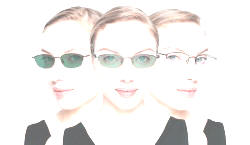
Transitions® is the market leader in this field, but
Corning’s SunSensors® is making inroads in this competitive market.
THESE LENSES ARE NOT SUNGLASSES AND SHOULD NOT BE SOLD AS A
FULL SUNGLASS!!!! In the car they will darken to about a #1.5 at most,
outside in the shade to maybe a #2 and outside in the sun to about a full
#3. If your patient is a sunglass wearer, tell them that Transitions will
make an excellent addition to their sunglasses. If they don’t wear
sunglasses these lenses will provide significant brightness control over
white, or lightly tinted lenses.
Both glass and plastic are sensitive to temperature and will
be darker in the cold than in warm temperatures. While it is true that
sticking photochromics in the freezer will cause lenses to darken quicker
than if you don’t, as soon as they warm up again they will revert to normal
color changing. All this really gives you is a quick change when just out of
the freezer and a cold face.
NEW! SPLITZ® is a variable tint version of the popular “club
tints”. SPLITZ lenses go from Yellow to Orange, Blue to Green and Rose to
Purple! Like all specialty lenses you will hardly ever sell them if you
don’t show them!
Return to Top
Ultra Violet Protection
Many authorities believe that Ultra Violet light is harmful
to the eye. This low cost protection may be of great long-term benefit to
the patient. Clear glass does not provide UV protection, a coating (very
ugly) can be used. Plastic lenses do not naturally provide UV protection,
but can be dyed with a special material to block UV rays. In plastic, this
process does not discolor the lens. All Hi Index and Poly lenses block the
required UV by nature of the material. No added treatments are required.
With the proliferation of drilled rimless in the market
today, we addressed this need by isolating drilled rimless Rx’s in their own
department.
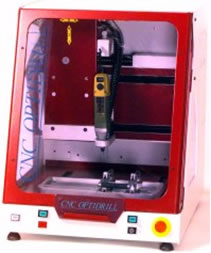
Specially trained staff with the latest in tools and equipment have built
Hollywood Optical’s reputation for quality drilled rimless to where it is
now, on a national level. Rx’s worth thousands of dollars routinely pass
through the lab on their way to satisfied customers like yourselves.
Drilled Rimless Material Choices
Materials that you should or should not consider using in
drill-mounted frames.
A couple items to keep in mind regarding what makes a
material desirable to use for drill mounting are Tensile Strength and
Flexural Strength.
Tensile Strength is defined as, the
resistance of a material to stretching without rupture.
Flexural Strength is defined as, the
strength of a material in bending, expressed as the stress on the outermost
fibers of a bent test specimen, at the instant of failure.
Polycarbonate rates very high in both these areas. There are
also a few other materials the have excellent Tensile and Flexural strength.
They include Trivex (Trilogy), MR10 (1.67), and MR7 (1.60).
We recommend you guide your patient away from the 1.50-1.56
materials (except Trivex) for all drill mounted frames.
Based on this you should feel confident in ordering your
High Index 160 and 167 materials when you need to have that high index
material in a drill mount frame.
If you follow these recommendations, you should see fewer
drill mounted frames back due to cracked lenses.
Return to Top
Polycarbonate has been used to make ophthalmic lenses for
approximately twenty years. When polycarbonate was first introduced, it was
viewed as a lens to be used for safety glasses due to its high impact
resistance. We later realized that this thinner, lighter, high index
material was a perfect choice for every day prescriptions. However, there
was a lot of bad press regarding the difficulties in processing, “low’” abbe
value, a grey coloration to the lens and carbon (black) specs. These issues
are no longer valid.
What is Polycarbonate?
Polycarbonate is a thermo plastic used in many industries.
It comes in clear, colored and opaque resins for injection molding
capabilities. The plastic cover on your car’s headlights and compact disk’s
are two great examples. Unlike thermosetting plastics, polycarbonate comes
in a resin form, it is melted down and then injection molded into a lens
using large molding presses. Polycarbonate is very soft and must be hard
coated. Even items such as compact discs are treated with hard coatings to
protect them from scratching. Polycarbonate does have a low abbe value (30),
however, it is also the lightest ophthalmic lens material, most impact
resistant, has a high index of refraction, UV protection and can be
processed to a very thin center thickness on mid to high minus
prescriptions. Even at this thin center, polycarbonate will exceed the FDA
requirements for impact resistance.
In the early years, there was a lot of bad press regarding
the “low abbe value”. I believe the majority of the bad press received early
on was not truly related to low abbe value. The real issue was the
manufacturing process. The techniques used induced large amounts of stress
in the lens. This stress created issues for the patients when trying to view
items off the optical axis. Although a low abbe value can create issues with
off axis blur, it is usually only symptomatic in patients with high
prescriptions. We can minimize the negative effects by selecting the proper
base curve and proper fitting.
As with any new material, manufacturing and processing
techniques have improved with time. The optical quality of polycarbonate
resin improved greatly with the introduction of compact discs. Their need to
have a purer, clear and spec free material allowed the optical industry to
have this clearer, cleaner material as well. Manufactures also modified the
melting chamber to help prevent any carbon specs.
This highly impact resistant material is capable of having
all the various lens features applied to it. This includes AR, Transitions®,
mirror coatings, etc. You also should be aware that approximately 80% of
your prescriptions will fall in the range of +2.00 to -3.00. You are less
likely to have any issues with “chromatic aberration” from patients in this
prescription range. Polycarbonate is the perfect material of choice for
three piece drilled rimless frames. It should also be your primary choice
for children and active adults. The only other option you should ever
consider in these situations is the new Trilogy material.
In summary, polycarbonate should be dispensed as your lens
material of choice. If you have not given polycarbonate a try in the past
few years, do yourself a favor and look at it again.